Since 1999

Books
- Details
NOTE: This is the International Edition.
For Indian Edition, please contact the author.
professor toofaanii publishers, East Lansing, MI USA is happy to announce their 96th book
PICTORIAL JOURNEY OF HINDI CINEMA 1953
Sanjeev Tanwar
A compilation of Hindi film posters of the year 1953. A collector's item. Year-wise collection of posters, cover page images of booklets, still photographs, etc. for the pleasure of re-visiting the Golden Era of the Silver Screen. The PICTORIAL JOURNEY OF HINDI CINEMA-1953 covers all posters of Hindi films made in 1953.
Full color, US Letter, paperback, 107 pages
Now You Know!
A few pages here


- Details
NOTE: The book is available on the following websites
pothi.com, notionpress.com, Amazon.in, flipkart.com
Please search with the name of the author and/or title.
professor toofaanii publishers, Lansing, MI USA is happy to announce their 49th book
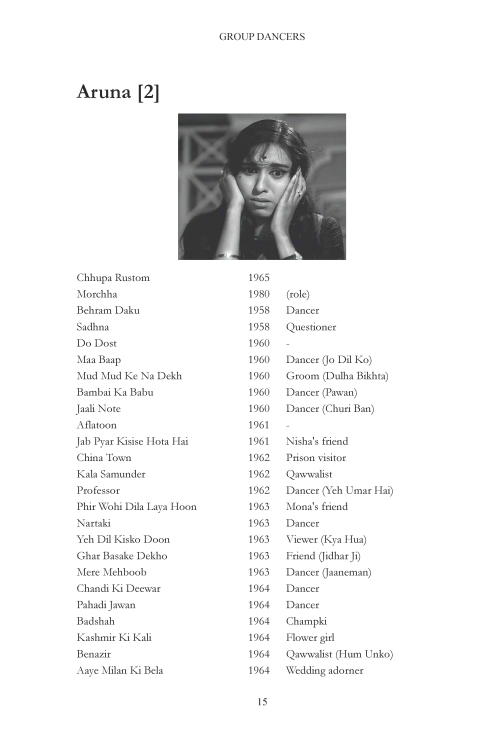
Group Dancers of Indian Cinema (Golden Age and Beyond)
by
Upendra Samaranayake
and
Professor Surjit Singh
Group dancers are also called chorus or backup dancers. Clearly, without them most of the dance sequences would not be too interesting. The reason is that solo performances by the lead characters are rare and usually occur in formal, classical dance settings. For an average movie-goer, these are not very appetizing. Most of the time, though, the main dancer or dancers have to be embedded in a matrix of backup dancers.
The tradition of having other dancers present when the leads are dancing goes back a long way. In the story of the divine dancing pair Radha-Krishna we have Radha's friends almost always present. In fact, sometimes they are so jealous of Radha that Krishna clones himself such that each of Radha's friends thinks that she is the one dancing with him alone.
Quite a few of the folk dances that grew in the middle ages had other dancers besides the lead, sometimes complementing, sometimes mimicking what he or she was doing. As we have seen many times before, this tradition was continued in the theater, silent films, and finally the talkies.
In the talkies, when the dances moved away from the temple or the court to other locations, a need arose for more dancers. These dancers were, unfortunately, very low in the movie industry hierarchy, just above the extras. The extras are the ones sitting in the cafeterias or in parties. You can actually recognize many of them who are common fixtures sometimes for years. Little bit above them are the unheralded group dancers. They are usually hired by dance directors, sometimes called the dance masters or simply masters. They work in groups, get to know each other and typically do not need much rehearsal. They work is reasonably hard, very enjoyable for those who love dancing and pays well, roughly about 5-10 times a secretarial or low-level desk clerk job.
Sadly not much has been written about them. One can forget about biographies, for the most part, even their names are unknown to an average film-goer.
This book is a small effort to name them and have their filmographies written down. Much work still needs to be done.
Paperback, 6 by 9 in, 209 pages. Ts 750 (India), $8.5 (US).
First 15 pages may be seen here


Now You Know!
- Details
Note: Available on lulu.com and pothi.com
professor toofaani publishers, East Lansing, MI USA is happy to announce their 73rd book
Early Hindi Film Advertisements III (1944-48)
N Ramaswamy
Professor Surjit Singh
Until recently, the only way to access old newspapers and magazines was to visit their offices, go through many hurdles and answer dozens of questions to actually see the old collections. Mercifully, most had been converted to microfilm for the convenience of the researchers.
Thanks to the advent of the internet and the latest digital technology, quite a few newspapers and magazines have been digitized and are available without visiting the dusty old archives. However, most of the digital collections are available only after paying hefty fees.
There are some silver lines among the clouds. Many big companies like Google and Microsoft have undertaken a massive effort to digitize every available print material and put it on the internet for free. Many world libraries, associations, museums, special collections are doing the same. A huge repository of such items in the Internet Archive.
In this book, we present more than 870 images of early talkies ads. We had a lot of fun working on them, to capture them and making them suitable for print, organizing them. We hope that you will also enjoy this peek into the early history of the talkies.
This book, third in the series, covers 1944-48.
Size by 9, pages 285, black and white
First few pages may be read here, as usual


Now You Know!
Page 26 of 66
